Document automation vs AI deck generators: when each one wins
A practical comparison of document automation versus AI deck generators — what each category solves, where each breaks, and a decision matrix for buyers.
Document automation and AI deck generators are different categories. AI generators (Gamma, Beautiful.ai, Tome) invent a new deck from a prompt: right for first drafts and one-offs. Document automation fills a designer-owned template from structured data: right for anything recurring, branded and bound to live numbers. When novelty is the value, prompt; when sameness is the value, template.
A marketing director sat in a demo last quarter, watched Gamma stitch a forty-slide deck out of three sentences, and walked out convinced the recurring-report problem was solved. Three weeks later her team was back to hand-editing the same monthly report — because the deck the AI produced looked nothing like the brand template, and nothing about it could be regenerated next month with fresh numbers from the warehouse.
That gap is where the confusion lives. The AI deck generators caught the headlines for the past two years. The category they’re in is real and useful, and underrating them is a mistake. But it isn’t the same category as document automation, and treating them as substitutes is how teams end up paying for both and getting full value from neither. The clean answer: prompt-to-deck wins for first drafts and one-offs, data-to-template document automation wins for recurring branded outputs. Most mature teams use both, in different parts of the stack. Read the document automation for the longer architectural treatment.
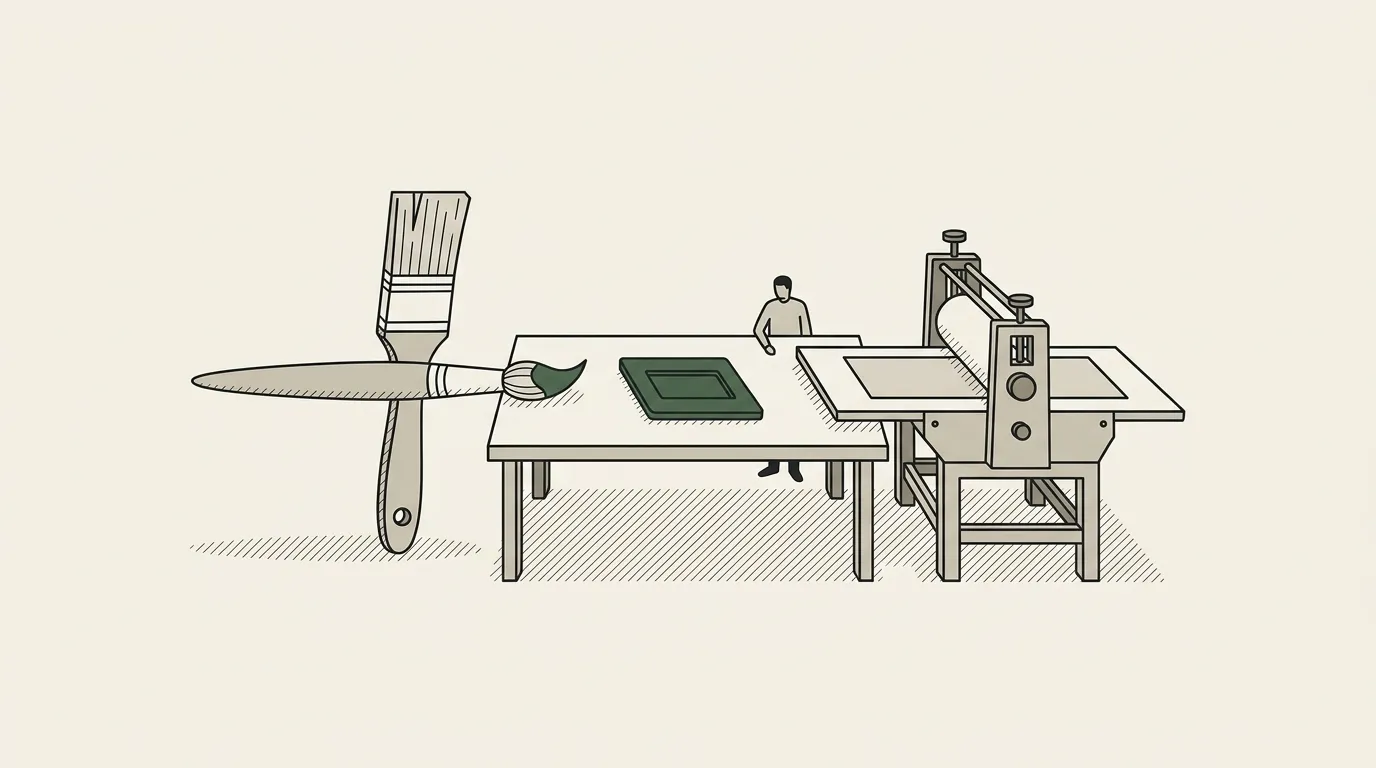
The two categories solve different problems
Start with the inputs and outputs and the difference falls out of the page.
An AI deck generator takes a prompt — sometimes a document, sometimes a URL, sometimes a sentence — and synthesises a deck. The output is novel each run. The system’s job is to invent a layout, choose icons, pick stock photography, write copy, and arrange it into a coherent narrative. The user’s job is to refine. Gamma, Beautiful.ai, Tome, Plus AI all live in this category. They’re optimised for the unblock — for getting a writer or strategist from blank-page to first-draft in ninety seconds. That’s a real category and they’re good at it.
Document automation takes structured data and a designed template, and produces a filled artefact. The template is owned by a designer in their native tool — Google Slides, PowerPoint, Word, InDesign. The data lives in a warehouse, an Airtable base, a CRM, a spreadsheet. The system’s job is to walk the template, fill in the data-bound regions, leave alone everything that shouldn’t change, and emit the same artefact shape every run. The user’s job is to maintain the template and the data. SourceToDocs, traditional document-generation platforms and template-driven render engines all live in this category.
The clean way to hold the difference: AI deck generators are creative, document automation is reproductive. Creativity is what you want when the artefact is new. Reproduction is what you want when the artefact has shipped fifty times before and has to ship fifty more.
Where each one wins
A few jobs make the choice obvious.
| The job | Pick | Because |
|---|---|---|
| The first-draft pitch deck | AI deck generator | No template, the story is the point; prompt, edit, send |
| The monthly board pack | Document automation | Same eighteen slides from a finance warehouse, brand-locked, audited; a prompt tool hallucinates a chart and loses the brand on slide twelve |
| The internal town-hall recap | AI deck generator | Low stakes, one-off, nobody checks the formatting |
| The QBR for two hundred customers | Document automation | The whole point is sameness; prompt-driven generation produces variety |
| The conference keynote | Neither | Hand-built by a design partner; automated keynotes look automated |
| The agency client report, white-labelled per client | Document automation | The client’s brand, the agency’s data, monthly, high volume; see agency client reporting |
The shared thread: when novelty is the value, AI deck generators win. When sameness is the value, document automation wins.
Where each one breaks
Both categories have honest failure modes.
AI deck generators break on brand consistency. The output is plausible, but the typography is the AI’s typography, not yours. The colour palette is the AI’s, not yours. The icon style is the AI’s, not yours. There are knobs to push the output back toward the brand — themes, custom fonts, locked colour swatches — and they help, but the underlying generative process is fundamentally creative, and creative systems drift. For a deck that has to look identical month over month, a few percent drift per run compounds into a deck that doesn’t look like the rest of the corpus by month four.
They also break on source of truth. The AI synthesises numbers from whatever input it was given. If the input is a paragraph, the AI will turn the paragraph into bullets and pick a chart shape that approximates the claim. The chart isn’t bound to the warehouse — it’s a one-time render of one-time numbers. Next month the chart has to be rebuilt by hand, or by re-prompting and praying the result looks similar to last month’s.
Document automation breaks on novelty. The template is the constraint, by design. If the artefact this month genuinely needs a different shape than last month, you have to update the template — which is the right behaviour for board packs and the wrong behaviour for “make me a quick one-pager about our new positioning.” The platforms in this category are not built to invent. They’re built to honour what was already invented.
They also break on bad templates. A template-driven platform multiplies whatever quality the starting template has. If the master deck was hand-stitched by an analyst rather than designed by a design partner, the automation will reproduce the hand-stitched aesthetic faithfully, on repeat. The fix is upstream — fix the template — not in the platform.
The maintenance dimension everyone underweights
The honest cost of AI deck generators isn’t the per-deck price. It’s the cost of redoing work next quarter when the prompt no longer produces the deck the team built last quarter. Generative systems are non-deterministic by design. Two prompts that look the same can produce two decks that look different. For a one-off, that’s a feature — the second draft might be better. For a recurring artefact, that’s a tax — every run starts with re-establishing the brand, the structure, the chart styles, the section ordering.
The honest cost of document automation isn’t the platform fee. It’s the upfront mapping work — connecting the template to the data, deciding which regions are dynamic and which are static, handling the conditional sections, validating the output the first few runs. Once that work is done, the marginal cost per run is near zero, which is the whole point. But the first run is more expensive than a prompt.
The buyer error in both directions: under-provisioning the AI deck generator’s ongoing cost, and under-provisioning the document automation platform’s setup cost. Teams that get value from both categories budget honestly for each.
A decision matrix
Five questions. Score each as “yes” or “no.” Tally the column.
| Question | If yes | If no |
|---|---|---|
| Will this artefact ship more than five times in the next year? | Document automation | AI deck generator |
| Is the data bound to a system of record (warehouse, CRM, Airtable, sheet)? | Document automation | AI deck generator |
| Does the brand have to look identical run-to-run? | Document automation | AI deck generator |
| Is the audience external (clients, investors, board)? | Document automation | Either |
| Is the value of this artefact in its novelty rather than its sameness? | AI deck generator | Document automation |
Three or more “document automation” pulls — it’s a document automation problem. Three or more “AI deck generator” pulls — it’s a prompt-to-deck problem. The mixed cases are where the choice gets interesting, and almost always the answer is “use both, on different artefacts.” The error to avoid is forcing one tool to do both jobs.
What to actually do this week
If the artefact in front of you right now is the monthly board pack, the QBR cycle, the agency client report, the investor update — open the document automation guide, list the four components (data, template, generation engine, orchestration) and find the gap. The gap is the project.
If the artefact is the keynote, the new sales narrative, the all-hands recap, the one-off pitch — open Gamma or Beautiful.ai, prompt your way to a first draft, and edit. Don’t engineer this. The engineering cost will outweigh the saving.
For the longer architectural treatment of the recurring-artefact case, read the document automation. For a deeper buyer’s view of the AI deck generator category, see Gamma alternatives for B2B teams.