Gamma alternatives for B2B teams that need brand consistency
Honest gamma alternatives for B2B teams that need brand-consistent recurring decks — Beautiful.ai, Plus AI, Tome, and template-driven platforms compared.
The right Gamma alternative depends on why Gamma stopped fitting. Beautiful.ai adds design discipline; Plus AI keeps your Google Slides master; Tome adds sales narrative; template-driven document automation (SourceToDocs) is the only option where the same data produces an identical deck every run. For recurring branded decks, that last one is the answer; for one-off drafts, stay with Gamma.
A founder told me last month that her sales team was generating decks faster than ever and her brand designer was quitting. They’d standardised on Gamma about a year before. The team loved it — eight prompts and a deck. The designer hated it — every output looked subtly off-brand, the colours drifted, the typography substituted, and she was spending half her week post-fixing decks that had already been sent.
That’s the gap this piece is about. Gamma is a good tool — for first drafts, for ideation, for unblocking work the user didn’t have time to start. The mismatch isn’t with Gamma; it’s with the assumption that a prompt-to-deck tool is the right shape for recurring branded outputs. B2B teams that run the same sales deck, the same QBR template, the same board update on a cycle need different gamma alternatives than what most “AI deck generator” lists recommend.
This piece walks through four serious options for B2B teams where brand consistency matters: Beautiful.ai, Plus AI, Tome, and the template-driven document automation category. Honest tradeoffs, not feature checklists. For the longer architectural take on AI deck generation in business contexts, the AI presentation generator for business covers the category at the system level.
| Gamma | Beautiful.ai | Plus AI | Tome | Template-driven (SourceToDocs) | |
|---|---|---|---|---|---|
| Shape | Prompt to deck | Prompt to deck, rule-based layouts | AI inside Google Slides | Prompt to deck, sales-narrative first | Designer master filled from data |
| Who owns the master | Gamma | Beautiful.ai’s master, rebuilt | Your Slides master | Tome | Your Slides or Docs master |
| Same input, same deck | No | Closer | No, content is prompted | No | Yes |
| Data binding | Paste | Paste | Prompt | Paste | Airtable, Sheets, SQL, API |
| Right for | First drafts in two hours | Teams leaving PowerPoint chaos without an existing master | Workspace shops wanting AI help on one-off branded decks | Bespoke sales pitches needing narrative scaffolding | Recurring decks that must be identical run to run |

What Gamma is actually good at
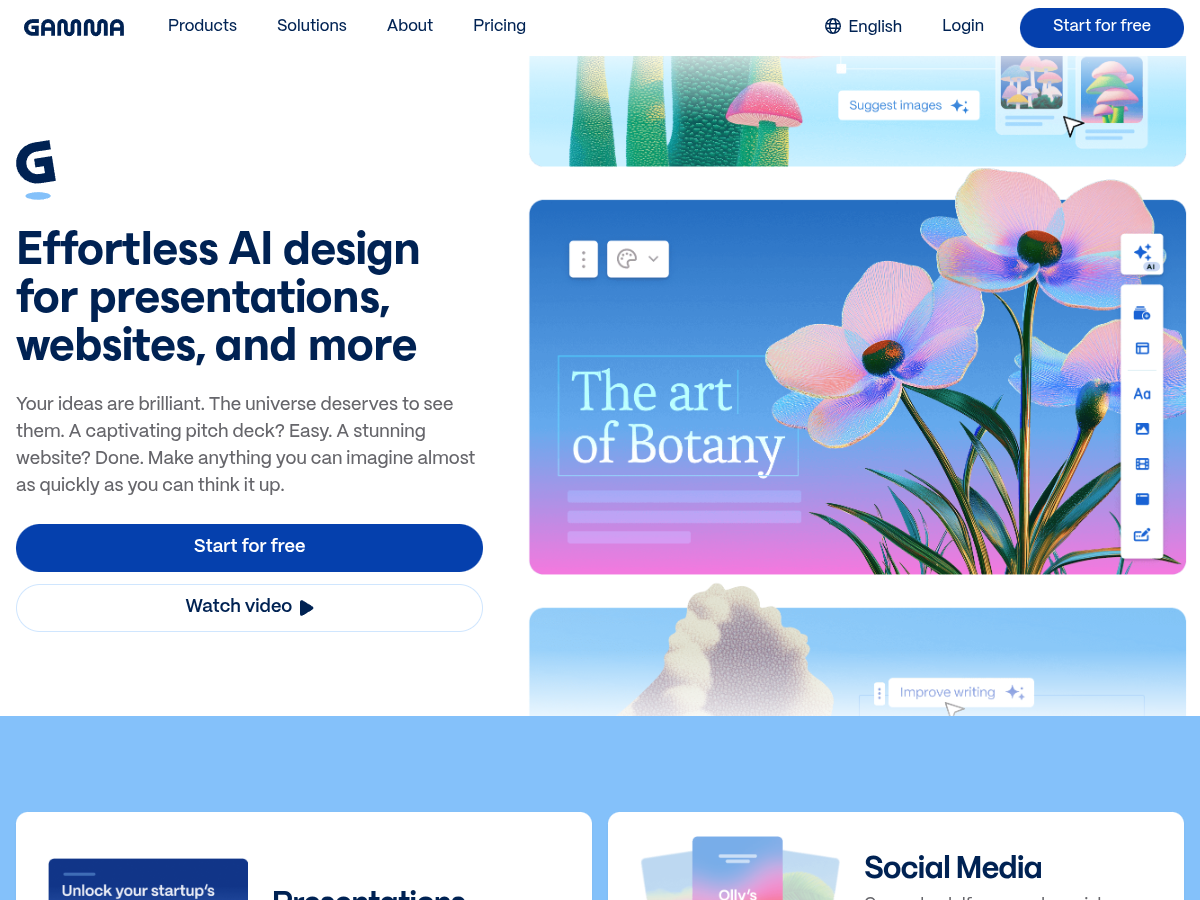
Before the alternatives, the steelman. Gamma is the easiest prompt-to-deck experience on the market. The first-draft surface is excellent — type a topic, get a structured deck back, edit by talking to it. For pitches that need to ship in two hours, for internal stand-ups where the deck is a glorified speaking outline, for ideation sessions where the deck is the brainstorm, Gamma is hard to beat.
The places it works for B2B specifically: founder-led pitches where each one is bespoke, content marketing decks where the look is supposed to vary, internal training where the team owns the brand and is fine with house style flexing. Don’t replace Gamma for those. Different jobs.
The places it doesn’t work: recurring decks where two outputs from different days have to look identical. Sales decks across a hundred reps that all need to read as one company. Customer QBRs where the brand fidelity is part of the customer relationship. Board updates that ship monthly and have to look like the same board update every month. The problem isn’t that Gamma’s output is ugly — it’s that the layout is regenerated each run, so identical-input, identical-day generations don’t produce identical decks.
That’s the gap the alternatives below address from different angles.
Beautiful.ai
Beautiful.ai is the closest direct competitor to Gamma in the prompt-to-deck space, and the one that pushes hardest on design discipline. The product’s pitch is that every slide layout is rule-based — drop a chart in a “stat” slide and it follows a template the design team built; add a fourth bullet to a list slide and the type re-scales, the spacing rebalances. The user can’t manually break the layout.
For B2B teams, this matters more than it sounds. The “design discipline” enforcement is a real backstop against the brand-drift problem. A rep who’s used to PowerPoint can’t accidentally make a slide that violates the brand because Beautiful.ai’s slide types don’t allow it.
Where Beautiful.ai wins versus Gamma: brand templates that hold across the team. A team can upload its brand guidelines, set up a master, and have the slide types render through it. The output is more uniform than Gamma’s, run-to-run.
Where it still falls short of full template-driven workflows: the master is Beautiful.ai’s master, not your designer’s master. If your brand design team works in Slides or PowerPoint and owns a master file there, you’re rebuilding the brand inside Beautiful.ai. And the layout is still rule-based generation rather than walking a fixed designer-owned template — for sales decks where the brand team has already invested in a Slides master, that’s a step back.
Right pick when: your team is moving from raw PowerPoint chaos toward something more disciplined and you don’t have an existing master file you’re attached to.
Plus AI
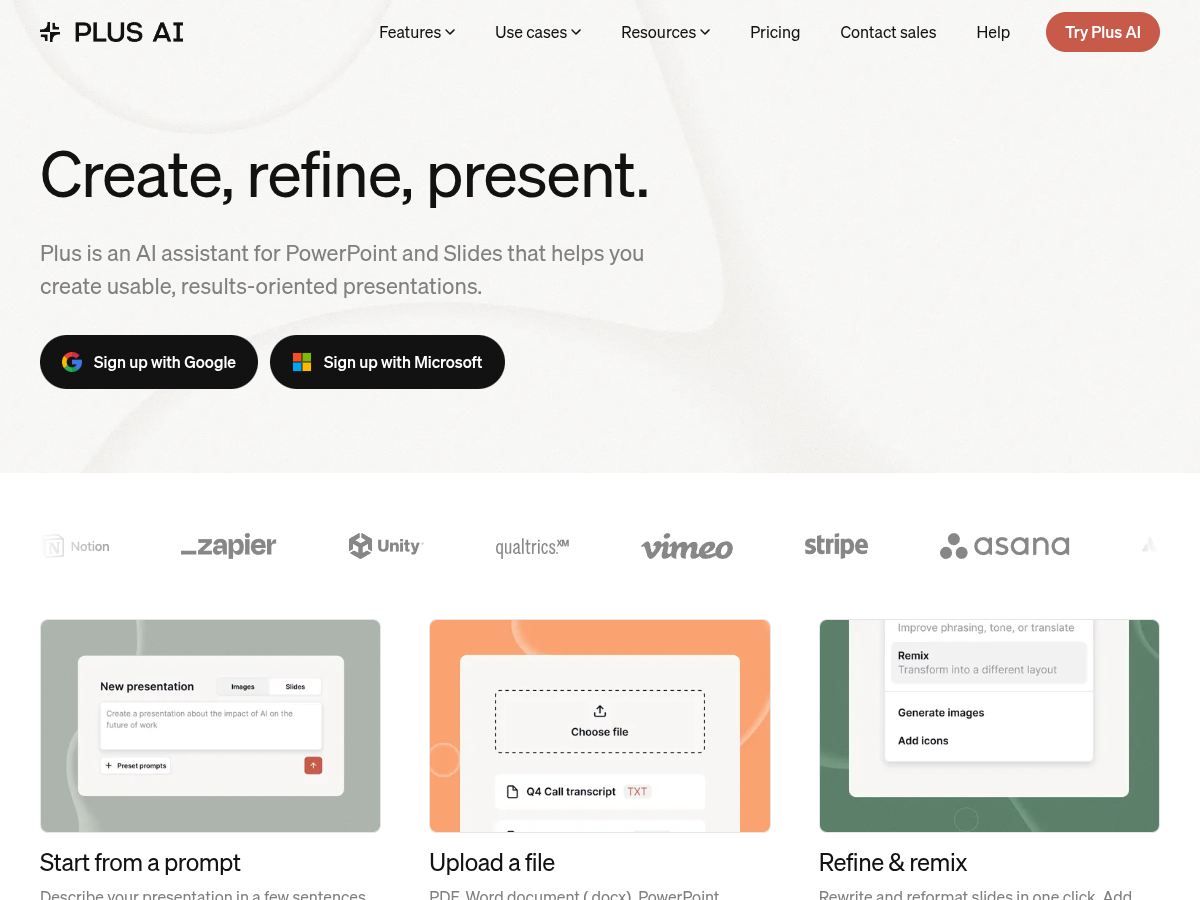
Plus AI is a different shape. It’s not a standalone tool — it’s an extension that runs inside Google Slides. You write a prompt, and Plus AI generates slides into your existing Slides deck, using the existing master. The brand template you and your designer already built stays the brand template; Plus AI fills it in.
For B2B teams that have already standardised on Google Workspace, this is often the right answer to the gamma alternatives question. The deck lives in Slides, where the rest of the company already shares and edits decks. The brand master is the master your design team owns. The AI is the content-generation layer, not the layout layer.
Where Plus AI wins: native Google Slides integration, brand master ownership stays with the team, no migration cost, the user can edit the output the same way they edit any Slides deck.
Where it falls short: it’s still prompt-driven for the content itself, so for recurring data-driven decks (sales QBRs, board updates) it’s not the shape. It’s better than Gamma for one-off branded decks; it’s not the shape for recurring data-bound decks. If your sales deck is the same fifty slides every quarter with fresh data, Plus AI inside Slides is a meaningfully better starting point than Gamma — but it still isn’t the template-driven, data-bound generation a recurring deck wants.
Right pick when: you’re a Google Workspace shop, your design team owns a Slides master, and you want AI assistance for one-off branded decks without the brand drift Gamma produces.
Tome
Tome went through a strategy shift toward sales enablement specifically. The pitch is “AI for sales decks” — the product knows what a sales deck is shaped like, what kinds of slides need to be in one, and generates accordingly.
For B2B sales teams, Tome’s relevance is whether the sales-specific opinion fits the way your team actually pitches. If your sales process maps onto Tome’s narrative arc, the product gets you a long way fast. If your sales process is bespoke (technical sales, channel sales, complex enterprise motions), the opinion is more cage than scaffolding.
Where Tome wins versus Gamma: the storytelling-first frame produces decks that read like sales decks rather than information dumps. The slides have a flow. The narrative carries.
Where it falls short for the brand-consistency question: same fundamental architecture as Gamma — the layout is generated, not template-driven. The brand is a configuration, not a designer-owned master. Run the same input twice and you don’t get the same deck.
Right pick when: you’re a sales-led B2B company where every deck is a unique pitch and you want narrative scaffolding more than you want layout determinism.
Template-driven document automation platforms
The fourth category — the one that’s a different shape from the first three — is template-driven document automation. SourceToDocs sits here, alongside platforms in the same shape.
The architecture inverts the prompt-to-deck model. The designer owns a master template in Slides, PowerPoint, or Word. The data lives in a warehouse, an Airtable base, a CRM. The platform sits in the middle, walks the master, fills in the data-driven parts, and outputs a deck that’s identical to the master in every way except the data. Same input, same day, same deck. Different data, different deck — but the same shape, the same colours, the same typography.
For B2B teams that ship recurring branded decks — sales decks across reps, monthly board updates, quarterly QBRs across the customer base, agency client reports — this is the shape that solves the brand-drift problem at the architectural level. The brand is not configured into the AI; it’s a Slides file the design team edits.
Where this category wins: brand fidelity is exact, runs reproducible, the deck is bound to a data source so the content is always current, the master is owned by the people who own brand at the company.
Where it falls short relative to Gamma: it’s not a first-draft tool. The setup cost is real — someone has to map the master to the data the first time. For a one-off pitch deck, this category is overkill.
Right pick when: the deck recurs, the brand has to be exact, and the deck content is bound to a real data source. Wrong pick when the deck is one-off, the design is fluid, or the team needs to ship the first draft in two hours.
Decision framework
Four questions in order. The first answer that’s “yes, strongly” tells you which of the gamma alternatives to pick.
| First “yes, strongly” | Pick |
|---|---|
| The deck recurs with the same shape and fresh data each run | Template-driven document automation; the prompt-driven tools structurally cannot hold a layout still |
| The design team owns a Slides or PowerPoint master you want to keep | Plus AI for Slides, or template-driven if recurrence applies; Beautiful.ai means rebuilding the master |
| Every deck is bespoke and sales wants narrative scaffolding | Tome; Beautiful.ai for more layout discipline; Gamma if speed is the only axis |
| A first draft you will edit heavily and the look can drift | Gamma. Do not overthink it |
For the parent treatment of AI deck generation in B2B contexts, including the broader feature comparison, read the AI presentation generator for business. For the head-to-head on where each tool fits, see SourceToDocs vs Gamma. For the architectural comparison of document automation versus AI deck generators, see document automation vs AI deck generators.